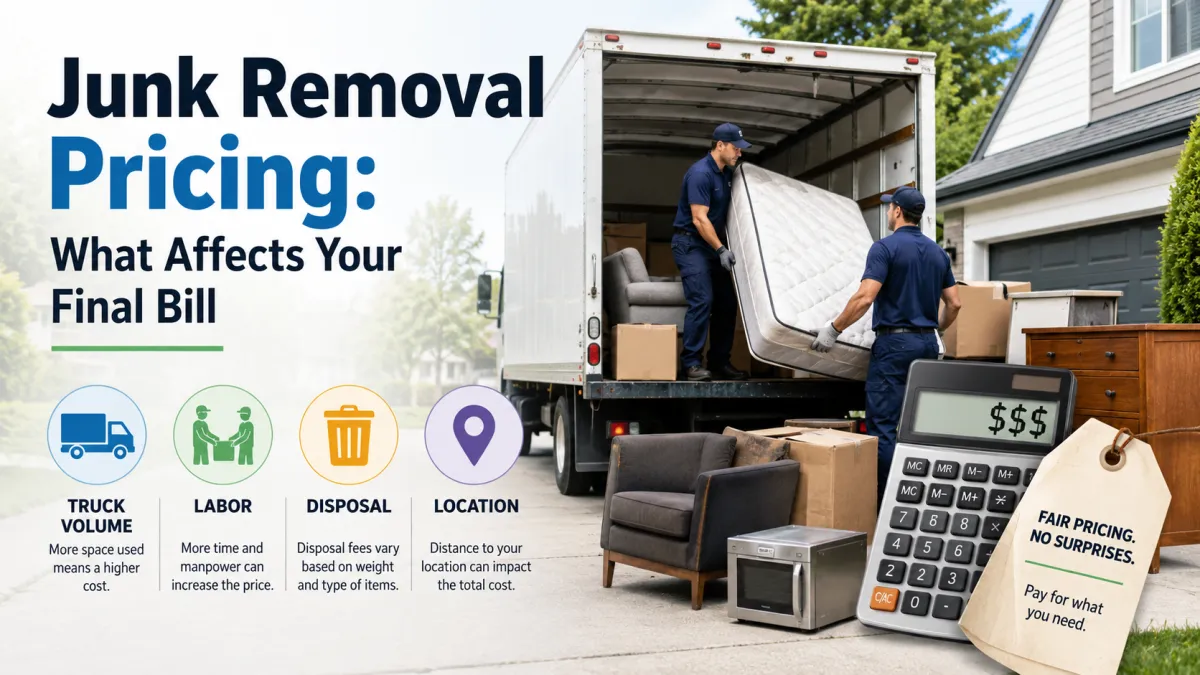
Junk Removal Pricing: What Affects Your Final Bill
According to Angi’s 2026 cost data, the average junk removal job runs about $241, but the part that surprises most people is the minimum. If you only need one mattress, a broken chair, or a few bags gone, junk removal pricing still usually starts with a service floor, not a tiny bill. This guide breaks down what actually affects your final price, what to ignore, and how to avoid paying more than you should.
What the minimum charge for junk removal usually looks like
Angi’s 2026 national pricing data, based on current homeowner cost trends, puts normal junk removal costs in the $133 to $372 range, with some small jobs starting lower and some large jobs climbing well past that. What this means in practice is simple: if you have only a few items, you will still often pay a minimum pickup charge because the company is sending a truck, crew, fuel, insurance, and disposal capacity either way.
That minimum often lands around the price of a 1/8 truckload, usually about $75 to $125 in many markets, though some companies start higher. If the item is awkward, heavy, or requires special disposal, the minimum can jump fast. A single curbside recliner may sit near the low end. A single mattress or fridge probably will not.
The reason companies do this is not mysterious. Even tiny jobs take time to schedule, drive to, load, unload, and process. A truck rolling for one lamp still burns fuel. A two-person crew still gets paid. The landfill or recycling stop still happens.
Here’s how to use it: ask every company for its minimum load charge before you discuss item-by-item pricing. That one question saves time because it tells you right away whether a small pickup is even worth booking.
How junk removal companies actually build your bill
A 2023 industry snapshot from Gitnux found that labor made up 42% of total junk removal business expenses. That matters because junk removal pricing is almost never one flat magic number. It is usually built from a few parts: how much truck space your stuff takes, how much work it takes to remove, and what it costs to dump, recycle, or donate.
The simplest way to think about your bill is this: space, effort, and destination. Space means volume in the truck. Effort means lifting, stairs, distance, and time. Destination means where the load ends up after pickup, because landfill, recycling centers, and special disposal sites all charge differently.
Two quotes can look wildly different for what seems like the same job because one company may include labor, cleanup, disposal, and taxes in the first number, while another starts low and adds fees later. That is why the cheapest quote on paper is often not the cheapest final bill.
The move that works is to ask for an itemized explanation of what the quote includes.
The simplest version of pricing: volume, labor, and disposal
A junk removal trends report from 2025 says three main factors drive most final bills: how much space the load uses, the labor required, and how the items are handled after pickup. That lines up with how experienced crews actually price jobs in the real world.
Volume usually leads because truck space is the easiest pricing unit. But labor can swing the total more than people expect. A half-load of loose bags at the curb is quick. A half-load of furniture in a basement with a narrow stair turn is not. Same volume, very different job.
Disposal is the third leg of the stool. Clean cardboard, metal, or reusable furniture may be cheaper to process than mixed trash, wet debris, or restricted materials.
What this means in practice: when you ask for a quote, describe the pile and the removal conditions, not just the items.
Why minimum charges exist even for a tiny load
A 2023 Gitnux report found that fuel expenses rose 18% year over year and averaged about $0.45 per mile for fleets. Add labor, insurance, dispatch, truck payments, and dump fees, and you can see why a “single item” pickup still has a price floor.
This is also why marketplace ads with very low starting prices can be misleading. Some informal haulers advertise minimums as low as $50, but professional operators carry more overhead and usually include more protection, better scheduling, and cleaner disposal records. That difference shows up in the price.
The practical takeaway is not to hunt for the lowest number. It is to make sure the minimum charge includes the whole job, not a small teaser that grows after loading starts.
Truck volume pricing: the biggest factor in most quotes
Angi’s 2026 pricing guide says pros often charge by cubic yards or truck fraction, and that model dominates the market. In plain English, the more space your pile takes in the truck, the more you pay. For most standard household jobs, volume is the biggest pricing driver.
This method works well for mixed loads because companies do not need to assign a separate price to every lamp, tote, chair, and broken shelf. They look at the total footprint instead. That is why customers who focus only on item count often guess low.
What this means in practice: take a photo of your pile next to something familiar, like a door, trash can, or parked car, and ask for a volume-based estimate.
Typical truckload price ranges
Angi’s current national ranges put a 1/8 load at about $75 to $125, 1/4 load at $125 to $200, 1/2 load at $200 to $400, 3/4 load at $400 to $600, and a full load at $600 to $800. Those are useful planning numbers, not promises. Dense cities, high dump-fee areas, and jobs with tough access can push them up. Small towns with lower overhead can bring them down.
Here’s where people get tripped up: a “small pile” can still eat a surprising amount of truck space if the items are bulky. An old sectional, a mattress set, and a dresser can fill far more than most people think. Air matters. Dead space matters too.
Use these ranges as your starting budget, not your final expectation.
How to estimate your pile before you book
This Old House’s pricing guide explains that most companies price by truck volume, not by time alone. So stop counting pieces and start thinking in chunks of space.
Picture your pile as a rectangle: width, depth, and height. If it is about the size of a washing machine or a couple of large chairs, you may be near a 1/8 load. A small closet cleanout or several pieces of furniture might be 1/4. A packed garage wall or spare-room dump pile can easily reach 1/2.
Loose, weirdly shaped items almost always cost more than people expect because they do not stack neatly. Bags compress. Bookcases do not. Branches, bed frames, and broken furniture waste space fast.
The action here is simple: take wide photos from two angles and show the full pile, not just close-ups.
Item type can raise or lower the final price fast
Angi’s 2026 item pricing data shows a wide spread: mattresses often cost $75 to $150, electronics $20 to $200, major appliances $60 to $250, bulky furniture $80 to $400, hazardous waste $150 to $300, and construction debris $100 to $800. That gap tells you something important. Not all junk is priced like junk.
Some items are easy to grab and toss. Others need careful lifting, refrigerant handling, recycling rules, or extra dump fees. A couch and a pile of moving boxes may take the same space, but they do not create the same work.
Here’s how to use it: make a simple item list and flag anything heavy, oversized, or restricted before you request quotes.
Low-complexity items vs high-cost items
A 2024 Data Insights Market report notes that specialized removals such as electronics and more complex jobs require extra handling and disposal steps. What this means in practice is that complexity often matters as much as size.
Low-complexity loads include bagged clutter, flattened boxes, small shelves, and light furniture. These are predictable. They load fast. They usually do not trigger special disposal rules.
High-cost items are different. Pianos, hot tubs, refrigerators, sleeper sofas, concrete chunks, and remodel debris all bring trouble. They can be too heavy for one worker, too awkward for tight corners, or too regulated for a normal dump run. That is why the bill climbs even when the pile does not look huge.
Items that often trigger extra fees
A 2025 junk removal trends report says regulatory pressure influences pricing because companies have to sort materials and send them to the right places instead of dumping everything together. That shows up most clearly with certain item types.
Mattresses often carry disposal fees. Electronics may need e-waste processing. Appliances with refrigerants cannot just be tossed in general landfill streams. Tires, paint, solvents, and hazardous waste may be refused entirely or scheduled separately. Renovation debris can be heavy enough to trigger weight-based disposal costs on top of volume pricing.
The takeaway: do not bury specialty items in a general pile and hope for the best. That is how quotes change on site.
Labor and access are where surprise charges happen
Angi says labor alone typically adds $100 to $300 to a junk removal job, and that tracks with reality. Access is where homeowners most often underestimate the job. The junk may be “just one couch,” but if that couch has to come down a narrow third-floor stairwell with a landing turn, it is not a one-couch job anymore.
Labor costs rise with time, difficulty, and crew size. Tight hallways, locked gates, backyard carry-outs, elevator waits, and disassembly all add minutes. Minutes become labor. Labor becomes your bill.
The practical move is to tell the company exactly where the junk is located and whether stairs, gates, or disassembly are involved.
Stairs, distance, and disassembly
This Old House recommends prepping items ahead of time because reducing loading time can lower labor costs. That advice is boring, honestly, but it works.
A sofa at the curb is fast money for a hauler. That same sofa upstairs, behind a baby gate, needing the legs removed, is a different quote. Same object, different labor clock. Long carries from a detached garage or backyard have the same effect.
If you can break down bed frames, remove dresser drawers, or move light items closer to the pickup point, you give yourself a better shot at the lower end of the range.
Curbside pickup vs full-service pickup
A 2023 consumer market report noted that customers increasingly expect fast, transparent service, but convenience costs money. Curbside pickup is cheaper because the crew does less. Full-service pickup costs more because the company handles the carrying, sorting, and often the cleanup too.
For many people, full-service is worth it. If the job involves heavy items, limited mobility, or a tight move-out deadline, paying extra makes sense. But if you are price-sensitive and physically able to prep the load, moving it to the driveway or curb can cut the bill.
The simplest version of this: pay for convenience only when you actually need it.
Disposal rules, landfill fees, and eco-friendly service affect the bill
The United States produces more than 290 million tons of municipal solid waste each year, plus over 600 million tons of construction and demolition debris. That is the background behind disposal pricing. Junk does not disappear when the truck leaves your house. It enters a costly system of transfer stations, landfills, recycling streams, and donation sorting.
A 2023 market report found that 58% of urban consumers preferred eco-friendly recycling services. What this means in practice is that greener removal is not just branding anymore. Customers ask about it, and companies build it into operations and pricing.
Your bill may reflect landfill tipping fees, recycling costs, mattress processing fees, or extra sorting time. Sometimes greener disposal costs more upfront. Sometimes it lowers the bill by diverting reusable or recyclable items out of expensive landfill loads.
Ask what percentage of your load will be recycled, donated, or landfilled.
Why mattresses, electronics, and debris cost more to dispose of
Gitnux reported that landfill tipping fees averaged $65 per ton in 2023. That is one reason dense, dirty, or regulated materials can get expensive quickly.
Mattresses are bulky and often charged separately at disposal sites. Electronics need proper e-waste channels. Construction debris can be both heavy and mixed, which raises sorting and tipping costs. Appliances may require refrigerant handling before disposal. The destination matters because each one has its own fee structure.
That is why two equal-size loads can price differently if one is mostly cardboard and metal while the other is broken drywall, old carpet, and a mattress.
When donation or recycling can lower your cost
A 2025 industry trends report explains that recycling and donations can help reduce landfill-related expenses. Here’s how to use it: separate reusable items before the crew arrives.
If a dresser, table, or box of housewares can be donated, it may reduce the paid junk volume. Scrap metal sometimes helps too. But do not assume all companies sort for free. Some will, some will not, and some charge extra labor for that step.
The move that works is to ask in advance whether separated donation or recycling piles can lower your quoted price.
Your location changes pricing more than most people expect
A 2023 market analysis noted that independent operators still control about 55% of the U.S. market. That tells you something useful: junk removal pricing is local. There is no one true national rate because labor, dump fees, route density, and competition vary block by block, not just state by state.
A small load in a suburb with easy parking and a nearby transfer station can be cheap. The same load in a dense city with high labor rates, traffic delays, and strict disposal rules can cost far more. Rural areas can go either way. Labor may be cheaper, but long travel distances can erase that benefit.
The action is simple: get at least three local quotes instead of relying on national averages.
Urban, suburban, and rural pricing differences
This Old House notes that prices can rise in areas with higher fuel, disposal, and labor costs. Urban jobs often look convenient from the customer side, but they can be expensive for the hauler. Parking is harder. Carry distance may be longer. Elevator time slows the crew. Disposal sites may also be crowded or farther away.
Suburban jobs are often the most straightforward. Easier truck access, driveways, and better route density can help. Rural jobs may have fewer disposal options and longer deadhead miles between stops, which can raise minimum charges.
So yes, the same couch can cost different amounts in different zip codes. That is normal.
National brands vs local operators
A 2023 industry report says more than 21,000 companies operate in the U.S., which explains why pricing varies so much. National brands often have cleaner systems, faster scheduling, and clearer estimate processes. Local operators may be more flexible, especially for odd jobs or price matching.
Neither is automatically cheaper. A local crew may beat a franchise on price. A franchise may include more in the base quote and end up the better value. Scope matters more than logo.
The move that works is comparing what is included, not just the sticker number.
Photo-based quotes and in-person estimates: how to avoid bill shock
A 2025 trends report says customers now expect clear pricing, online booking, and advance estimates, and many companies now offer photo-based estimates. That is a good shift. Clearer quoting usually means fewer ugly surprises.
Photo quotes work well for simple curbside piles, visible garage cleanouts, and single-item removals. In-person estimates are better for hoards, tight access, hidden materials, or jobs where volume is hard to judge. The catch is that not all estimates are binding. Some are rough ranges. Others are final if the photos match the job.
Ask whether the quote is binding or subject to change before you book.
What to include in your photos for a more accurate quote
Research and Markets reported in 2025 that better job data improves pricing accuracy. That is exactly what clear photos do.
Take wide shots from multiple angles. Show the full pile, not only the neat front view. Include a door, person, trash can, or vehicle for scale. Photograph stairs, gates, narrow hallways, or long carry paths. If there are hidden items behind the main pile, show those too. For specialty materials like TVs, paint cans, or appliances, include close-ups.
Clear photos reduce the chance that the crew arrives, sees a bigger or harder job, and revises the price upward.
Questions to ask before you say yes
A pricing comparison guide from Main Choice recommends asking whether labor, disposal fees, and taxes are included. That is exactly the right instinct.
Use simple language. Ask: Is this quote for everything? Does it include labor, hauling, disposal, and taxes? Are there extra charges for stairs, long carry distance, appliances, mattresses, or same-day service? Is there a time limit once the crew arrives? If the load is slightly bigger than expected, how will the price change?
One clear question beats five vague ones. Ask what could make the final bill higher.
Common ways people accidentally overpay for junk removal
According to Angi, comparing multiple quotes and separating hazardous or specialty items can reduce costs. In real jobs, overpaying usually comes from simple mistakes, not bad luck. People book too soon, forget to mention access issues, mix restricted items into general junk, or pay a private hauler for things the city or retailer would take for less.
Another common mistake is paying to remove usable goods that could have been donated or picked up elsewhere. If half your pile is still usable, your paid junk volume might be smaller than you think.
The action here is straightforward: separate donation, recycling, municipal bulk pickup, and true junk before you call anyone.
Booking multiple small pickups instead of one larger load
A 2023 pricing guide noted that many companies have a minimum fee for small loads. That is why repeated tiny pickups get expensive fast.
If you book one chair this week, two boxes next week, and a mattress later, you may pay three minimum charges instead of one quarter-load or half-load rate. Volume pricing becomes more favorable when you bundle.
Unless you are dealing with an urgent move-out or landlord deadline, waiting a few days to combine items is often the cheaper move.
Not checking city bulk pickup or retailer haul-away options
This Old House says homeowners can save money by using municipal bulk pickup and donation options where available. That advice is especially useful for mattresses, appliances, yard waste, and moving boxes.
Many cities offer scheduled bulk pickup for large household items. Some appliance stores haul away old units when delivering new ones. Cardboard may be free through local recycling. Yard waste often has its own city collection rules.
Private junk haulers are great for mixed loads and speed. They are not always the cheapest answer for one very specific item.
Sample junk removal price scenarios by job type
Angi’s national ranges are useful, but examples make the math easier to trust. These are not exact quotes, just realistic ways junk removal pricing tends to play out in the field.
Match your job to the closest scenario and use that as your starting budget.
Small pickup: one mattress or a few items
A single mattress at the curb may land around $75 to $150, especially if local disposal rules add a fee. A few light household items might still trigger the same minimum charge even if they take less space than a mattress.
This is why small jobs often feel overpriced. You are paying for the trip as much as the junk.
Medium job: garage, attic, or spare-room cleanout
A garage corner cleanout, attic purge, or spare-room dump pile often lands in the 1/4 to 1/2 truck range, roughly $125 to $400 before any unusual access or specialty-item charges.
This is where junk removal gets better value per item. Once the truck is already there, adding more standard clutter usually costs less than booking another trip later.
Heavy-load job: appliances, renovation debris, or bulky furniture
A job with old appliances, broken furniture, and construction debris may start near half-load pricing but rise because labor and disposal are doing more of the work than simple truck math. A debris-heavy haul can run from a few hundred dollars to $800 or more if the materials are dense, dirty, or hard to access.
Heavy jobs are where honest descriptions matter most. If the load includes tile, drywall, concrete, or refrigerators, say so up front.
How to estimate your junk removal bill before you book
Angi’s 2026 benchmark of about $241 average cost is useful, but averages do not build a personal budget. A better method is to start with the minimum charge or the truck fraction you think you need, then adjust for the few things that push prices higher.
The simplest version of estimating works surprisingly well because the industry is not that mysterious. Most quotes come back to volume, labor, disposal, and location.
Write down your estimated truck fraction and one possible surcharge before you request quotes.
A simple estimate formula you can use
Start with one of two numbers: the company’s minimum charge for a small pickup, or the truck-volume tier that matches your pile. Then add likely specialty item fees for things like mattresses, appliances, e-waste, or debris. Then adjust for labor and access, such as stairs, long carries, disassembly, or tight spaces.
So the formula is basically this: base pickup charge plus volume tier, plus specialty item fees, plus access or labor add-ons.
Keep it rough. You do not need a perfect number. You need a smart range that helps you spot a bad quote.
When to expect the final bill to change
Research and Markets noted in 2025 that final scope can change on arrival, which is why modern pricing systems use photo documentation and configurable rules. In plain English, the bill usually changes for predictable reasons.
The load is bigger than described. Hidden items appear behind the pile. Access is worse than mentioned. The crew finds prohibited materials mixed in. The job takes much longer than expected because items need extra breakdown or special handling.
Most price changes are avoidable. The fix is honest photos and honest descriptions.
The best way to get a fair price this week
A 2023 market report found that companies compete on transparent pricing, online booking, and fast response because customers expect clarity now. That is good news for you. The easiest way to control junk removal pricing is not to become an expert in hauling. It is to give accurate job details and compare clear quotes on the same scope.
Focus on four things: the minimum charge, the volume tier, any restricted or specialty items, and whether the quote includes labor, disposal, and taxes. If one company is much cheaper, find out why. Sometimes it is real efficiency. Sometimes it is missing scope.
What to try this week: photograph the pile, list any special items, and get three binding or clearly scoped quotes from local providers.
Frequently Asked Questions
What is the minimum charge for junk removal?
For many companies, the minimum charge lines up with about 1/8 of a truckload, often around $75 to $125. In some markets it is higher, especially if the item is hard to handle or needs special disposal.
Why does one item sometimes cost so much to remove?
Because you are not only paying for the item. You are paying for the truck, crew, travel time, fuel, insurance, and disposal run. A single item still uses the company’s time and route space.
Is junk removal priced by item or by truckload?
Usually by truck volume, though some companies also use item pricing for common things like mattresses, appliances, or TVs. The final quote often combines both methods when specialty items are involved.
Do stairs and upstairs pickups really change the price?
Yes. More carrying time means more labor, and labor is one of the biggest cost drivers in junk removal. A couch at the curb and the same couch on a third floor are not the same job.
Can photo estimates be trusted?
Usually yes, if the photos are clear and complete. Send wide shots, include scale, and show access points. Then ask whether the quote is binding or if it can change when the crew arrives.
How can you lower your junk removal bill?
Bundle items into one pickup, move what you can to an easy-access spot, separate donations and recycling, check city bulk pickup options, and get at least three local quotes. Those five moves cut overpaying more than anything else.
